

Table of Contents
- Why Original Art Prints Confuse Even Seasoned Collectors
- Original Print vs Reproduction: The Difference That Decides Value
- How to Identify a Lithograph and Other Printmaking Techniques
- How to Read Art Print Edition Numbers, Proofs, and Signatures
- Your At-Home Inspection Workflow: Magnification, Dot Patterns, and Paper
- Art Print Provenance and Certificate of Authenticity: What Counts as Proof
- Buying, Valuing, and When to Call an Expert
- Frequently Asked Questions
Last Updated: October 12, 2026
Why Original Art Prints Confuse Even Seasoned Collectors
Most people assume a pencil signature on original art prints means value. That assumption costs collectors money every year.
The confusion comes down to language.
At DeezTeezPleez, we spend a lot of time around printed artwork, from our own archival posters. So we built this guide to a practical, at-home method for telling them apart: the seven checks that matter most.

Original Print vs Reproduction: The Difference That Decides Value
An original print is created by the artist from a matrix they made by hand, pulling each impression themselves or supervising a master printer.
That distinction drives everything. Original prints sit in museum collections and auction catalogs. Reproductions, even expensive ones, are decorative.
Here's the fastest way to sort them:
- Original print: the artist made the plate, stone, or screen
- Reproduction: a printer photographed an existing painting or drawing
- Both: can be signed, framed, and sold at a gallery
The Metropolitan Museum of Art's essay on printmaking explains how the matrix, not the image, defines what counts as an original.
Original Prints vs Unique Paintings: Two Different Categories
A painting is a one-of-one object; an original print is one of a planned group, called an edition. Neither is better, but a lithograph is not a cheap painting, it is a different medium with its own rules, market, and authentication process.
Where Digital Prints and Modern Production Fit
Digital prints, including giclée, are made from a digital file rather than a hand-cut matrix. Many are high quality, printed on archival paper with pigment inks, but they are reproductions unless the artist created the file as the original artwork itself. Giclée is a marketing word: it tells you the printer used pigment inks on fine paper, not that the piece is an original.
How to Identify a Lithograph and Other Printmaking Techniques
Most guides tell you to "look at the texture" and stop there, not enough to tell a screenprint from a lithograph from an etching. What follows is technique-specific: the observable surface and ink characteristics that separate each major printmaking method. Start with the matrix, every traditional technique is defined by how ink transfers from it to paper, and that transfer leaves a physical signature you can see or feel.
Lithography
A lithograph is printed from a flat stone or metal plate, with image and non-image areas separated by chemistry rather than carving. Ink sits on the surface, so the printed area feels smooth and slightly flat under raking light. Under a loupe, look for a fine, grainy stipple in the tonal areas, the texture of the stone itself.
Etching and Engraving (Intaglio)
In intaglio, ink sits in grooves cut or bitten into a metal plate, and the plate is pressed into damp paper under high pressure. That pressure leaves a plate mark, an indented rectangle around the image, one of the strongest signs of a hand-pulled intaglio print. Under magnification, etched lines look irregular and tapered because acid bites unevenly; engraved lines look crisp and uniform because they were cut by a tool.
Woodcut and Linocut (Relief)
In relief printing, the artist carves away everything that should stay white and inks the raised surface. The result is bold, often high-contrast lines with visible gouge marks and the occasional slip of the tool. Edges of printed shapes can look slightly rough or chipped. Because the block is pressed directly onto the paper, you may see a faint impression of the block edge rather than a metal plate mark.
Screenprint (Serigraphy)
A screenprint is pushed through a fine mesh stencil, one color at a time. The ink layer is noticeably thicker than in most other techniques, often a slight raised film you can feel. Under raking light, screenprints show sharp, flat color blocks with hard edges and no tonal gradation unless the artist deliberately used halftone or blend techniques.
Digital and Giclée Prints
Digital prints, including giclée, are made from a digital file rather than a hand-cut matrix. Many are high quality, printed on archival paper with pigment inks. But they are reproductions unless the artist created the file as the original artwork itself. Under a loupe, inkjet prints typically show a fine, irregular spray or a stochastic (randomized) dot pattern rather than the regular halftone grid of offset printing.
What Each Check Can and Cannot Prove
Surface and ink characteristics can narrow the technique and rule out whole categories of reproduction, but they cannot confirm that a specific artist made a specific impression. A skilled reproductive printer can imitate a plate mark, and a digital file can mimic lithographic grain. Use technique identification as a filter, not a verdict, then move to edition notation, signature inspection, and provenance.
How to Read Art Print Edition Numbers, Proofs, and Signatures
How to read art print edition numbers starts with the fraction, usually written in pencil below the image. The bottom number is the total edition size; the top number is that specific impression.
Then look at the letters:
- A/P or Artist's Proof: pulled outside the main numbered edition, usually for the artist
- H/C: hors commerce, or "not for sale," given to collaborators
- P/P: printer's proof
Signatures follow the same logic. A pencil signature below the image, on the paper itself, is standard for original prints. A signature printed inside the image is part of the artwork, not a hand signature.
Your At-Home Inspection Workflow: Magnification, Dot Patterns, and Paper
You can do a meaningful inspection in about ten minutes with a loupe, good light, and a notebook.
My Hero Academia x Marvel Crossover Poster — Anime Superhero Team Art Print →
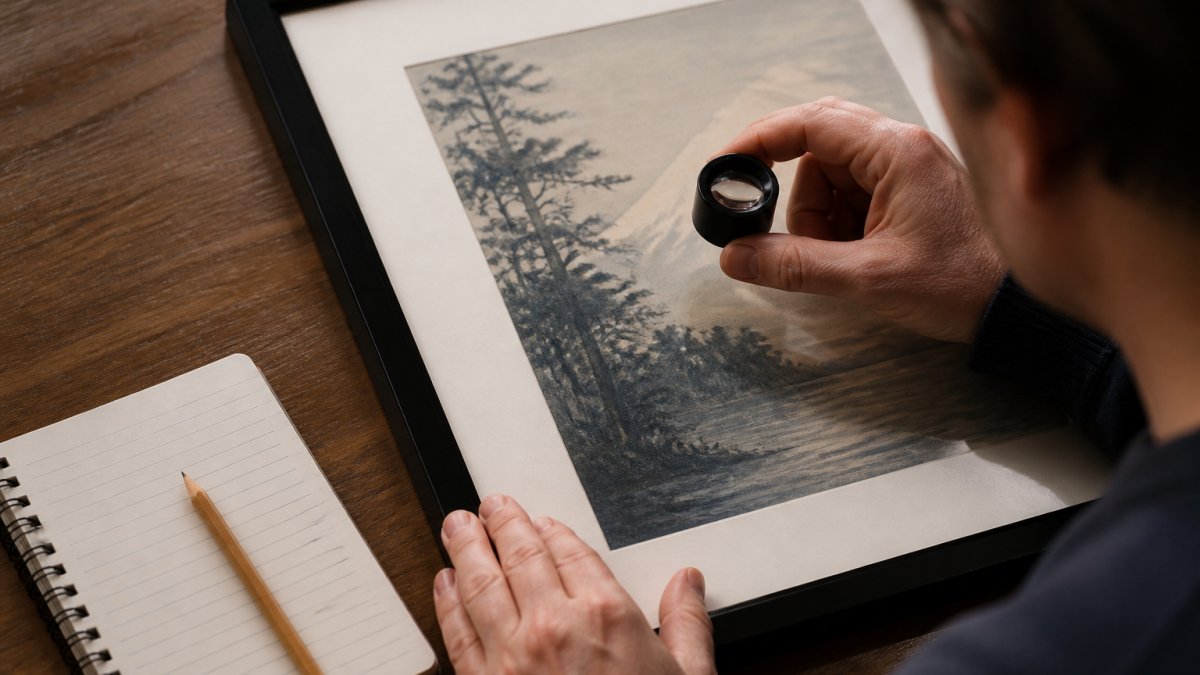
Start with magnification. A 10x jeweler's loupe is enough for most checks.
Step-by-Step: How to Examine an Art Print at Home
- Set up even, angled light. A desk lamp raking across the surface reveals texture and embossing.
- Check the paper edges. Deckled, uneven edges suggest handmade or mold-made paper. Clean machine cuts suggest commercial stock.
- Look for a plate mark. A pressed rectangle points to intaglio printing.
- Magnify the image area. Look for a regular grid of tiny dots.
- Inspect the signature under the loupe. Real pencil strokes show grain and slight variation. Printed signatures look flat and uniform.
- Read the edition notation. Confirm the fraction, letters, and placement.
- Photograph everything. Date-stamped photos help if you later seek an appraisal.
Halftone dots are the giveaway. Commercial offset and digital printing reproduce images as a grid of tiny dots. Hand-pulled prints do not have that grid. If you see a uniform dot pattern under magnification, you are almost certainly looking at a reproduction or a digital print.
| Check | Original Print Signal | Reproduction Signal |
|---|---|---|
| Paper edge | Deckled, uneven | Clean machine cut |
| Plate mark | Present | Absent |
| Surface under loupe | Continuous ink, grain | Regular halftone dot grid |
| Signature | Pencil, textured strokes | Printed, flat, uniform |
| Edition notation | Handwritten fraction or letters | None, or printed text |
Art Print Provenance and Certificate of Authenticity: What Counts as Proof
Art print provenance and certificate of authenticity are the paperwork side of the same question. Provenance is the documented ownership history of a piece; a certificate of authenticity states who made the work and when.
Here is the honest part most sellers will not tell you: a certificate is only as good as the issuer. One from the artist, the publisher, or a recognized gallery carries weight.
What Strong Provenance Actually Looks Like
Strong provenance is a chain, not a single document. Look for:
- Receipts or invoices from previous sales, with dates and names
- Gallery or auction records naming the piece, ideally with a lot number
- Exhibition history listing the work in a catalog or checklist
If the story changes between documents, treat it as a warning sign. A single gap is normal for older work; a pattern of gaps, or shifting details, is not.
How to Verify Documents (Not Just Read Them)
Verification means checking the claim against an independent source. Practical steps:
- Match the edition number on the print to the number recorded in the publisher's or gallery's documentation.
- Check the artist's catalogue raisonné if one exists, a scholarly catalog of the artist's known works that lists editions, sizes, and printers.
- Contact the publisher or printer named on the documentation. Many keep records and can confirm whether a number was issued.
- Search auction databases for the same edition and compare recorded details.
- Look for the printer's chop, a small embossed stamp, often in the lower margin, identifying the workshop that pulled the edition.
A certificate that cannot be matched to any of these is a claim without a source.
What a Certificate Can and Cannot Establish
A certificate can establish that someone, at some point, asserted the work is by a given artist. It cannot establish that the assertion is true. Certificates are easy to produce and copy, and frequently issued by parties with a financial interest in the sale. Treat one as a data point, not a conclusion.
When to Escalate to Professional Authentication
Visual inspection and document checks narrow the field but do not close the case.
Call a professional appraiser or a prints specialist at a major auction house when:
- The asking price runs into the thousands
- The edition is small and the artist is well known
- The seller cannot produce clear provenance
Before you contact a specialist, gather clear photographs of the front, back, margins, signature, edition notation, and any chops or stamps, plus all documentation and a written description of how you acquired the piece.
For everyday collecting, the advice is simpler: buy what you love, learn the medium, and let your eye get sharper with each piece.
Buying, Valuing, and When to Call an Expert
If you want printed artwork that is honestly described and made to last, our archival poster collection is printed on museum-grade paper with pigment inks, and our stretched canvas pieces come ready to hang.


Frequently Asked Questions
How can you tell whether an art print is an original or a reproduction?
Start with the markings. An original art print usually carries a pencil signature, an edition number like 12/150, and sometimes a blind stamp or chop mark. Then inspect the surface with a magnifying loupe: original prints show plate marks, ink texture, or the grain of a woodblock or stone, while reproductions often reveal a uniform halftone dot pattern or a flat, glossy digital surface. Finally, ask for provenance and a certificate of authenticity before you buy.
What should I look for in an art print's signature and edition number?
Look for a pencil signature rather than a printed one, since pencil is standard for hand-signed limited editions. The edition number appears as two figures separated by a slash, such as 45/200, where the first number is the impression and the second is the total run. Also check for artist's proof markings like A/P or E/A, which indicate a proof outside the main numbered edition. A signature alone does not prove authenticity, so pair it with provenance.
What documents help verify an art print's provenance and certificate of authenticity?
A useful paper trail includes the original gallery or publisher invoice, prior auction records, a signed certificate of authenticity from the publisher or artist's estate, and any exhibition history. Provenance is the ownership history of the piece, so dated receipts and catalog entries carry more weight than a standalone certificate. If the seller cannot show where the print came from, treat the claim as unverified and price it accordingly.
When should I ask an art expert to authenticate a print?
Bring in a professional when the price is significant, when the edition is described as rare or sold out, or when the markings look inconsistent with the artist's known practice. A qualified appraiser or a specialist at a major auction house can compare the print against catalogues raisonnes and known impressions. Expect authentication to involve examining the paper, ink, signature, and provenance together, since no single feature proves authenticity on its own.
Telling an original print from a reproduction comes down to patience and a loupe, not a degree. The collectors who get burned are the ones who trust a signature and skip the paper.
If you would rather start with artwork that is described honestly from the first click, DeezTeezPleez prints every piece on archival, museum-grade stock with fade-resistant pigment inks. Browse our posters and canvas wall art, find something that fits your space, and build your collection from a place of confidence.